
Last updated: 7 August 2026. Monthly averages describe a typical year, not the one you travel in — and PAGASA currently has an El Niño advisory running across the 2026–27 dry season. Treat the tables below as a planning baseline, not a forecast.
Some links on this page are affiliate links. If you book through them, IslaVisit earns a commission at no extra cost to you. How this works.
The best time to visit El Nido is mid-January to mid-March. That window sits inside the amihan (northeast monsoon) dry season, when seas in Bacuit Bay are calmest and island-hopping tours run most reliably — but it falls after the Christmas and New Year price spike and, in 2027, before an unusually early Holy Week (21–28 March). The broader dry season runs roughly November to April or May, and the wet habagat season roughly June to October, though sources disagree on the exact boundaries because the transition months genuinely move year to year. If you want the lowest prices and can accept cancelled boat days, June and early July offer the best value; August and September are the wettest and riskiest months of the year.
On this page
- When the seasons actually run
- Month by month: conditions, crowds, prices, risk
- Why the rainfall numbers online don’t agree
- The 2026–27 wildcard: El Niño
- Philippine holidays and what they do to rates
- Tour cancellation risk, honestly
- What the season does to flights, hotels and fees
- So when should you go?
- Plan the rest of your trip
- Frequently asked questions
El Nido is one of the few destinations where the month you choose changes not just the weather but whether the main activity happens at all. Almost everything you came for — the lagoons, Bacuit Bay, the karst islands — requires a boat, and boats do not leave in rough water. That makes timing a genuine decision rather than a preference.
When El Nido’s seasons actually run
Two monsoon systems drive the year, and they are worth understanding properly rather than as labels.
Amihan is the northeast monsoon. Cool, dry air pushes down from mainland Asia behind a strengthening high-pressure area, and PAGASA typically announces the transition in October. It brings the driest, brightest weather of the year and, in Bacuit Bay, the calm water that makes the lagoons look like the photographs. It also brings wind — amihan surges can put a stiff breeze and a short chop on exposed crossings even on a cloudless day, which is why a sunny January morning can still produce a cancelled Tour C.
Habagat is the southwest monsoon. Warm, wet air is drawn off the Indian Ocean and the West Philippine Sea, and it hits Palawan’s western coast head-on. PAGASA puts its typical onset in the second half of May or the first half of June. Habagat rarely means all-day rain; the usual pattern is a bright morning building to a heavy afternoon or evening downpour. What it does mean is swell, and swell is what stops boats.
Where sources disagree, and why. You will find El Nido’s dry season described as November to April, November to May, December to May and October to May, all with confidence. The disagreement is real and it has a cause. PAGASA classifies El Nido’s part of Palawan as a Type I climate — two pronounced seasons, dry roughly November to April, wet the rest of the year — while PAGASA’s national framing splits the calendar into a dry season of December to May and a rainy season of June to November, then subdivides the dry half into cool-dry and hot-dry. Both are official. They describe different things. Layer on the fact that habagat onset genuinely shifts by several weeks from year to year and the boundaries stop being fixed at all.
The practical takeaway: treat December to March as reliably dry, July to September as reliably wet, and treat November, May and June as coin flips. Book those months with a flexible itinerary rather than a fixed one.
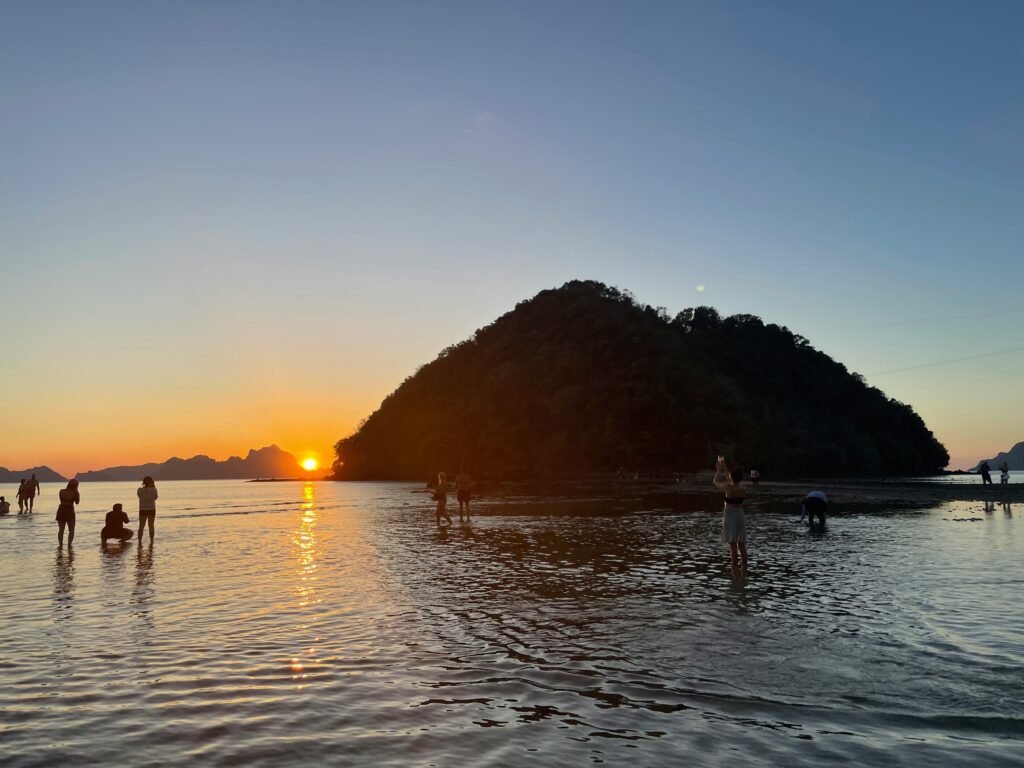
El Nido month by month
Crowd and price levels below are relative to El Nido’s own year, not to other destinations. Cancellation risk refers to boat tours being suspended, which in El Nido is a decision made each morning by the Philippine Coast Guard.
| Month | Conditions | Crowds & prices | Cancellation risk |
|---|---|---|---|
| January | Amihan at full strength. Dry, bright, occasional windy days. | High crowds, high prices; eases after the first week | Low, but wind can stop Tour C |
| February | Driest month of the year on every dataset. Calm seas, best visibility. | High crowds, high prices | Lowest of the year |
| March | Dry and hot. Amihan fades; the hot-dry stretch begins. | High crowds, high prices; spikes in Holy Week | Low |
| April | Hottest month. Dry, humid, strong sun. | Peak crowds; typically the dearest month to fly | Low |
| May | Transition. Early May often still dry; showers build late month. | Crowds thin, rates drop 20–40% off peak | Low to moderate, rising |
| June | Habagat arrives. Bright mornings, heavy afternoon rain. | Low crowds, low-season rates | Moderate |
| July | Wettest or second-wettest month depending on dataset. | Very low crowds, lowest rates | High |
| August | Wettest or second-wettest. Peak national typhoon month. | Very low crowds, lowest rates; some operators close | High |
| September | Still wet. Highest humidity of the year. | Lowest crowds; typically the cheapest month to fly | High |
| October | The improver. Rain eases through the month. | Low crowds, shoulder rates | Moderate, falling |
| November | Amihan returns, usually mid-month. Genuinely variable. | Crowds build late; best value in the dry season | Moderate early, low late |
| December | Dry and clear. Cooler nights. | Moderate to 20 December, then the year’s highest rates | Low |
If you only remember one row: February is the safest month to visit and September is the riskiest. Everything else is a trade between price and probability.
Why the rainfall numbers you find online don’t agree
This is worth flagging plainly, because you will otherwise assume one of these pages is authoritative.
Across four widely-cited climate-averages sites, El Nido’s driest month — all four agree it is February — is given as 5mm, 14mm, 47mm and 49mm. That is a tenfold spread for the same month in the same town. The wettest month is July at around 371 to 400mm on some datasets and August at around 433mm on others. Annual totals near 2,487mm appear on more than one site. And at least one popular weather-averages page lists El Nido’s hottest month at 15°C and its coldest at 4°C, figures that clearly belong to somewhere else entirely.
The reason is that El Nido has no long-running PAGASA synoptic station of its own. Climate sites interpolate from gridded models or borrow from Puerto Princesa and Coron, both of which sit in different exposures. Small differences in method produce large differences in output for a coastal town backed by limestone hills.
So use the ranking, not the millimetres. Every dataset agrees on the shape of the year: February and March are driest, July through September are wettest, and the swing between them is enormous. That ordering is reliable. The precise figure for any given month is not, and any guide quoting one to the decimal place is projecting a confidence the underlying data does not support.
The 2026–27 wildcard: El Niño
Most “best time to visit” guides describe an average year. The coming season may not be one.
As of its 26 August 2026 update, PAGASA reports a moderate to strong El Niño present in the tropical Pacific, and expects it to continue into the first half of 2027, possibly reaching a very strong state before the end of 2026. Its August-to-January outlook put the chance of El Niño conditions persisting through the first half of 2027 at around 97%, and favoured a very strong event across the October–December and November–January seasons at around 81%. This followed the end of a weak La Niña in March 2026.
PAGASA’s standing guidance is that El Niño increases the likelihood of below-normal rainfall. For a traveller, that tilts the odds in a specific direction: the 2026–27 amihan season may be drier and more reliable than a typical year for island hopping, with fewer washed-out days — but also hotter, with more pressure on local water supply by the March to May hot-dry stretch.
Read that as a tilt, not a promise. An ENSO advisory shifts probabilities across a season; it tells you nothing about your particular week. It is a reason to feel slightly better about booking a November or May shoulder trip this year than you would in an average one. It is not a reason to skip travel insurance.
Philippine holidays and what they do to rates
El Nido is not only an international destination. Domestic travel drives its sharpest price spikes, and those spikes are tied to dates you can look up in advance. One 2026 budget guide puts the increase during Christmas–New Year and Holy Week at 50 to 100% above normal rates — a larger swing than the entire difference between peak and low season.
Confirmed 2026 dates. These come from Proclamation No. 1006. The ones that still matter this year:
- Complete Palawan travel guide — all three destinations compared, and how to combine them.
- El Nido itinerary — 3, 5, 7 and 10 days planned out, with tour sequencing.
- 21 August (Friday) — Ninoy Aquino Day, and 31 August (Monday) — National Heroes Day. Two long weekends bracketing the end of August.
- 1 November (Sunday) and 2 November (Monday) — All Saints’ and All Souls’. Undas is a major domestic travel week, and making 2 November non-working creates a proper long weekend.
- 30 November (Monday) — Bonifacio Day, and 8 December (Tuesday) — the Feast of the Immaculate Conception.
- 24, 25, 30 and 31 December — Christmas Eve, Christmas Day, Rizal Day and the last day of the year are all non-working. This cluster produces the most expensive week of El Nido’s year. Book it three to six months out, or choose different dates.
- Best time to visit Coron — the same question for the other Palawan hub.
Holy Week 2027 falls unusually early: 21 to 28 March. Palm Sunday is 21 March, Maundy Thursday 25 March, Good Friday 26 March, Black Saturday 27 March and Easter Sunday 28 March. Easter’s date is astronomically fixed, so those are certain even though the holiday proclamation is not yet issued. This matters more than usual, because in 2027 Holy Week lands inside the best-weather window rather than after it. If you are planning a March 2027 trip for the weather, aim for the first three weeks and be out before the 20th.
A caution on 2027 lists. The Philippine government had not issued the 2027 holiday proclamation at the time of writing, so every 2027 calendar circulating now is a projection. At least one widely-shared 2026–27 planning calendar repeats 2026’s 17 February Chinese New Year into 2027, which is wrong — the date moves each year with the lunar calendar. Fixed-date holidays such as Christmas and Rizal Day are safe to plan around; anything movable should be confirmed against the official proclamation once it is published.

Tour cancellation risk, honestly
This is the part most seasonal guides skip, and it is the part that decides whether your trip works.
The Philippine Coast Guard makes the call, each morning, for everyone. Not your operator, not your weather app. If conditions are judged unsafe, no boats leave, regardless of what you paid or how sunny it looks from the beach. Travellers regularly report two consecutive no-boat days in the wet season.
Tour C is cancelled most often, because it runs furthest into open water. On marginal days it sometimes goes ahead with Hidden Beach dropped from the route, since that stop is the hardest to reach in swell. Tours A and D stay closer to sheltered water and survive more days. If you have one boat day and want the best odds, that is an argument for booking A first. Our guide to Tours A, B, C and D covers what each one actually visits and which is worth your money.
Refund terms vary far more than the tour prices do. Most operators reschedule you or refund when the Coast Guard suspends sailing — but not all do so in full. One El Nido operator’s published terms deduct an administration fee of PHP 250 per person per tour from a weather refund. Another charges a booking fee of PHP 2,000 per guest that is explicitly non-refundable under any circumstance. Read the weather clause before you pay a deposit, not after.
Two rules that cost nothing. Never book your only tour on your last day in El Nido — leave at least one spare morning. And between June and October, plan an extra night beyond what the itinerary needs, because you may simply lose a day.
This is also the point at which insurance stops being paperwork. Palawan is less typhoon-exposed than Luzon or the eastern Visayas, but it is not exempt, and PAGASA’s records for 1948 to 2024 put July, August and September at the highest average tropical-cyclone frequency of the year, at roughly three storms a month entering the Philippine Area of Responsibility. If you are travelling then, a policy covering trip interruption and weather cancellation is worth the cost. Compare travel insurance quotes on EKTA and read the cancellation wording rather than the headline price.
What the season does to flights, hotels and fees
Flights swing hardest. Google Flights and Cheapflights both put April as the most expensive month to fly into El Nido and September as the cheapest. (Note that since 29 March 2026 the El Nido flight departs Clark rather than Manila — see how to get to El Nido.) Booking-lead-time advice conflicts — one platform suggests around 75 days ahead, another around 40 — and at least one aggregator disagrees with the rest entirely, naming July as peak and November as cheapest. Set a price alert rather than trusting any single tool, and price both El Nido (ENI) and Puerto Princesa (PPS) for your dates, because the gap between them moves enormously by season. Compare fares to ENI and PPS on Aviasales before committing to either airport, then read our guide to every route into El Nido to see which one is actually worth the fare difference.
Hotels swing next. One Kayak-sourced dataset puts El Nido’s average room at roughly $45 in low season against $84 in peak. Independent guides put wet-season rates 30 to 50% below peak and May at 20 to 40% below. Those ranges are broad, but they agree with each other well enough to plan on.
The aggregator “cheapest month” widgets do not. One major booking site names June and September to October as cheapest with April and December to January dearest; a second names June cheapest and August dearest; a third names August the cheapest month and November the most expensive, quoting a 237% swing. These are computed from each site’s own search sample rather than from El Nido’s actual occupancy, and they should not be used to pick your dates. Where you stay changes your costs at least as much as when — our El Nido hotel guide breaks down what each area costs you in money and convenience.
Fees do not swing at all, and this catches people out. The Eco-Tourism Development Fee (ETDF) was raised to a regular rate of PHP 400 under Municipal Ordinance 01, Series of 2024. It is valid for ten days and reusable across every tour in that window, so keep the receipt. A great many pages still quote the older structure of PHP 200 for ten days or PHP 500 for longer stays, and one 2026 source quotes PHP 414 — budget PHP 400 and carry small notes. Big Lagoon and Small Lagoon each charge around PHP 200 to enter on top of that, and kayak hire at the lagoons is separate again. None of this gets cheaper in low season.
Peak season buys you weather and costs you access. Daily visitor caps at the lagoons are enforced, and from roughly December to April the slots are the real constraint. Operators report peak-season permits selling out before 08:00, permits not being released more than three to seven days ahead, and Small Lagoon being substituted for Big Lagoon when the day you booked is already full. Published figures for the cap disagree — 500 people, 400 per lagoon and 800 all appear in circulation — so confirm the current number and your slot with your operator rather than assuming. Tours A and C sell out first. Book El Nido island hopping ahead on Klook if you are travelling between December and April. In June or September, booking on arrival costs you nothing and keeps you flexible when the forecast turns.
So when should you go?
| If you want… | Go | The trade-off |
|---|---|---|
| The best odds on every tour running | February | Highest prices, busiest lagoons, permits needed early |
| Great weather without the peak spike | Mid-January to mid-March | Avoid Holy Week, 21 to 28 March in 2027 |
| Dry-season conditions at shoulder prices | Late November or early May | Genuinely variable; keep the itinerary loose |
| The lowest prices you will find | June to September | Expect to lose boat days; build in spares |
| Quiet lagoons above all else | June or October | Rain, and some operators run reduced schedules |
Is El Nido worth visiting in the wet season? Honestly, sometimes not. If you have four days, one shot at this trip, and the lagoons are the reason you are coming, August and September are a poor bet, and we would rather you moved the dates than booked cheaply and lost the boat days. If you have a fortnight, flexible plans and a real interest in paying half price for the same islands, the wet season is a fair trade. The difference is not the weather. It is how much slack your itinerary has.
Sources we checked: Amihan and habagat definitions, and the country’s climate types, come from PAGASA on the climate of the Philippines. El Niño status and outlook come from PAGASA’s ENSO monitoring page, last updated 26 August 2026. Monthly rainfall figures come from commercial climate-averages datasets rather than a PAGASA station, which is exactly why they disagree. Checked 15 September 2026.
Plan the rest of your El Nido trip
- Complete El Nido travel guide — getting there, when to go, tours and where to stay, in one place.
- Where to stay in El Nido — the four areas compared side by side.
- El Nido island hopping: Tours A, B, C and D — which tour survives marginal weather, and which one to book first.
- How to get to El Nido — every route from Manila, Coron and Cebu, and why the fare gap between ENI and PPS moves by season.
- Best hotels in El Nido — where to stay by area and budget, and which areas hold their rates in low season.
- Philippines travel budget — what a week actually costs once transport and fixed fees are counted.
- Philippines travel planning checklist — eTravel, cash and connectivity before you fly.
- Coron vs El Nido — how the two Palawan hubs compare on cost, diving, beaches and getting there.
- Best time to visit the Philippines — how the timing differs region by region.
Frequently asked questions
What is the best month to visit El Nido?
February is the best single month. It is the driest month of the year on every available dataset, seas in Bacuit Bay are at their calmest, and boat-tour cancellations are at their lowest. The trade-off is that it is also among the busiest and most expensive months, and lagoon permits need booking well ahead.
What is the rainiest month in El Nido?
July or August, depending on the dataset. Some climate sources put July highest at roughly 371 to 400mm; others put August highest at around 433mm. All of them agree that July, August and September are far wetter than any other month, and that February is the driest.
Is El Nido worth visiting during the rainy season?
It can be, if your plans are flexible. Accommodation runs roughly 30 to 50% below peak rates and the lagoons are quiet. But boat tours are suspended by the Philippine Coast Guard on rough days, and losing two days in a row is common. If you have fewer than five days, or the island hopping tours are the whole reason for your trip, choose different dates.
Does it rain all day in El Nido during the wet season?
Usually not. The typical habagat pattern is a bright morning building to heavy rain in the afternoon or evening. The problem for travellers is not the rain itself but the swell that comes with the southwest monsoon, which is what causes boat tours to be cancelled.
When is Holy Week 2027, and should I avoid El Nido then?
Holy Week 2027 runs from Palm Sunday on 21 March to Easter Sunday on 28 March, with Maundy Thursday on 25 March and Good Friday on 26 March. It is one of the two busiest domestic travel weeks of the Philippine year and rates can rise 50 to 100%. If you are travelling for the weather rather than the atmosphere, aim for the first three weeks of March 2027 instead.
Do island hopping tours in El Nido get cancelled often?
In the dry season, rarely. From June to October it is common, and the decision is made each morning by the Philippine Coast Guard rather than by tour operators. Tour C is cancelled most frequently because it goes furthest into open water. Never book your only tour on your last day, and check your operator’s weather-refund terms before paying, as some deduct an administration fee.
What is the cheapest time to visit El Nido?
June to September. Accommodation drops roughly 30 to 50% below peak rates, and September is typically the cheapest month to fly from Manila while April is typically the dearest. Fixed costs do not fall: the PHP 400 Eco-Tourism Development Fee and the roughly PHP 200 lagoon entry fees are charged year-round.
How far ahead should I book for peak season?
For travel between December and April, book accommodation and island hopping tours several weeks ahead, and considerably further for Christmas, New Year and Holy Week. Lagoon permits are capped daily, and operators report peak-season slots filling before 08:00, with permits often not released more than three to seven days in advance.
Next steps
- Pick your tours before you fix your dates: Tours A, B, C and D compared
- Price the seasonal swing on both airports: Compare flights to ENI and PPS
- Choose a base that suits your month: Best hotels in El Nido