Last updated: 30 September 2026. Research findings below are cited to the published studies. Fees are contested between sources, and we explain why rather than picking one.
Some links on this page are affiliate links. If you book through them, IslaVisit earns a commission at no extra cost to you. How this works.
Quick answer: Oslob is the most reliable whale shark encounter in the Philippines and the most criticised. The sharks are there every morning because fishermen feed them, and that is the entire argument. Budget roughly PHP 1,000 per foreign visitor for the in-water activity, go at 6am, and read the research section below before you decide whether to go at all. If a non-fed encounter matters to you, Donsol and Southern Leyte are the alternatives, and they come with a real trade-off: you might not see anything.
What actually happens at Tan-awan
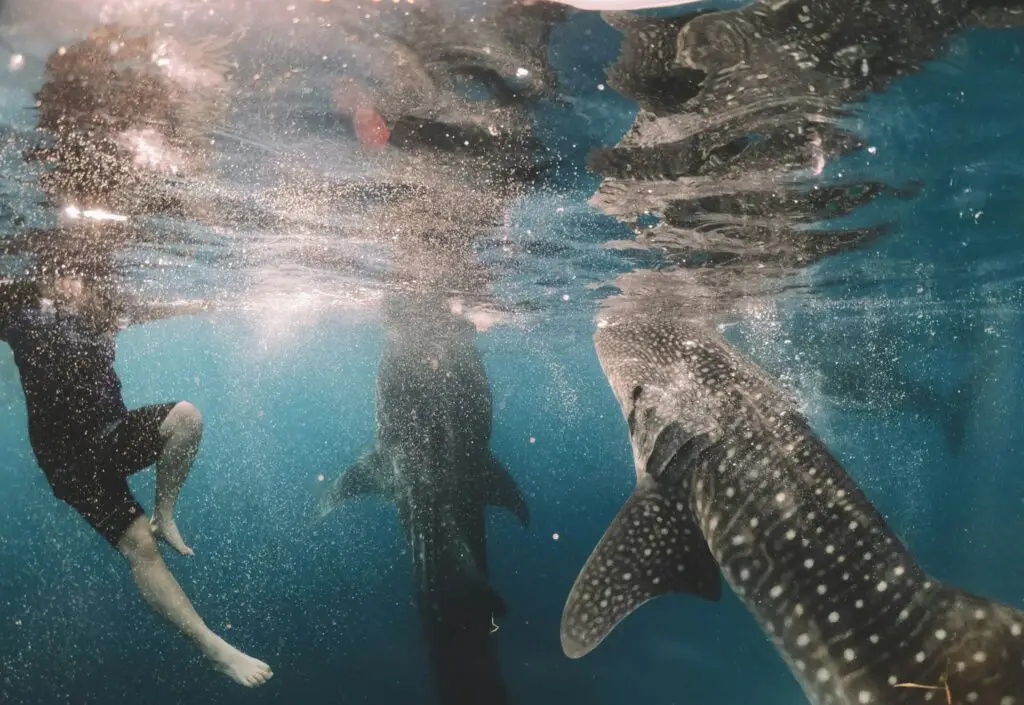
Whale shark watching in Oslob takes place at Barangay Tan-awan, a roadside stretch of coast about 10 kilometres from Oslob town proper. It is not a boat trip to a distant reef. The interaction area sits a few minutes’ paddle from shore in water around ten metres deep.
The sequence is the same for everyone. You register at the booth on the main road, sit through a mandatory briefing covering the rules, collect a life vest and mask, and are assigned to a paddle boat with a local bangkero. You are taken out, you get a fixed window in the water of roughly thirty minutes, and then you rotate out so the next group can come in.
Each morning the fishermen scatter small amounts of uyap, a shrimp and krill paste, into the water. The sharks come inshore for it. This is why Oslob works every single day of the year when every other whale shark site in the world is seasonal and uncertain, and it is also the reason the site is controversial.
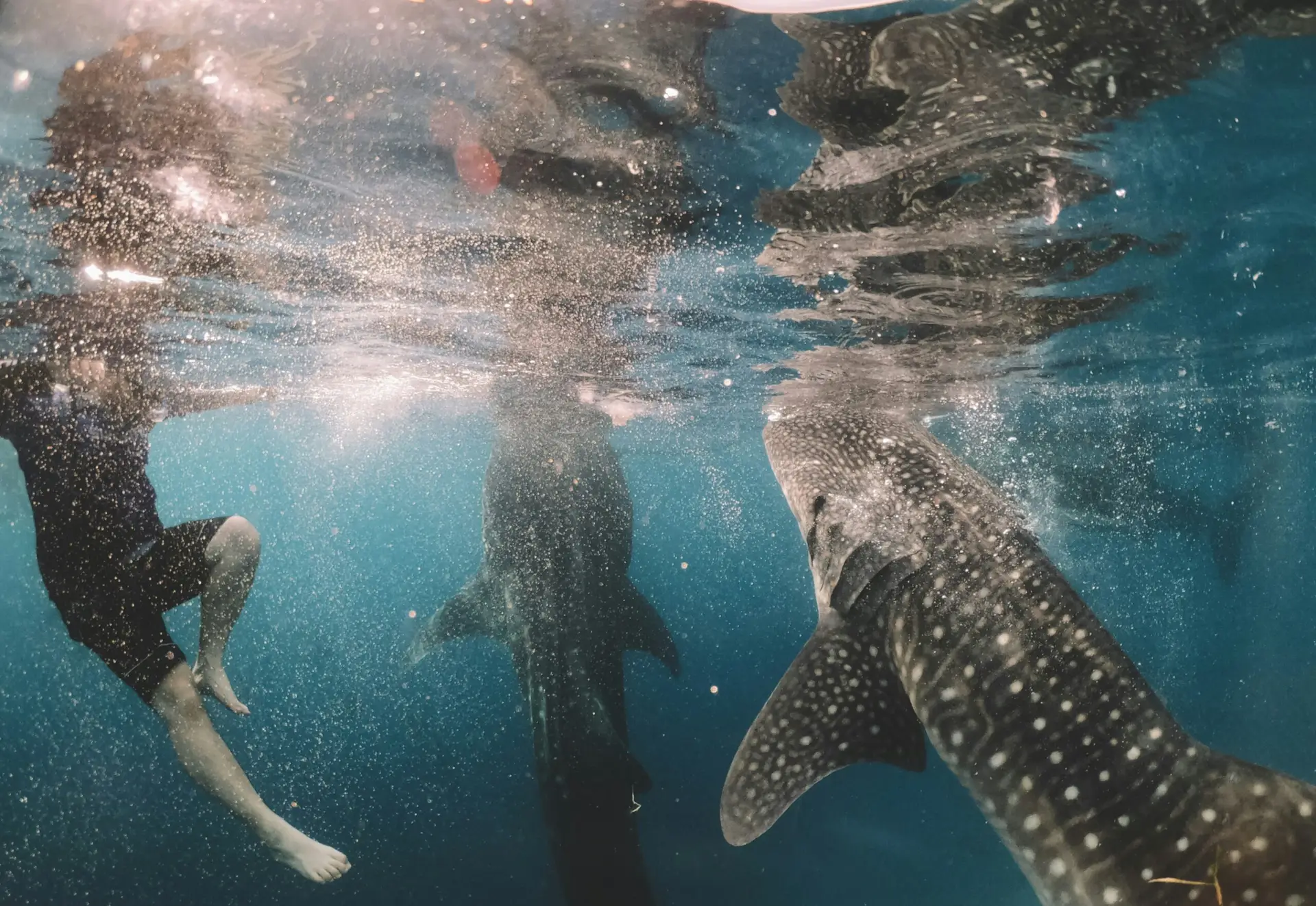
The operation is community-run and has been since 2011, when Tan-awan’s fishermen shifted from regarding whale sharks as a nuisance to building a livelihood around them. Fee income is split by ordinance between the fishermen’s association, the municipality and the barangay. LAMAVE counted 98,000 visitors in 2012 and 508,000 in 2018, with ticket sales estimated at about USD 10 million a year as far back as 2016, which makes it the largest provisioned whale shark tourism operation anywhere in the world.
What it costs, and why the published price is contested
We are going to be unusually blunt here, because every other guide states a confident figure and they do not agree with each other.
There are two rate structures circulating, both attributed to municipal ordinance:
| Structure | What it says | Where it comes from |
|---|---|---|
| Tiered by nationality | Snorkelling around PHP 500 for Filipinos and PHP 1,000 for foreign visitors; diving around PHP 1,000 and PHP 1,500. Sometimes quoted with a separate environmental fee of about PHP 100. | The research institute that worked at the site reported exactly this split — PHP 1,000 for foreign visitors and PHP 500 for Filipinos for a 30-minute swim — and several operators and local businesses repeat it. |
| Flat rate | A single PHP 1,000 per person for the activity, with no separate entrance fee, and paid extras for snorkelling upgrades, gear and photography. | Quoted by several 2026 Cebu-focused sources. |
| Per activity, no nationality tier | PHP 500 for snorkelling including boat and gear, PHP 1,000 for diving. | Published by a long-running Tan-awan operator on its own booking page. |
They cannot all be current at once. What they agree on is the number that matters to most readers of this site: a foreign visitor should budget about PHP 1,000 per person for the in-water activity, in cash, plus extras.
What we are not going to do is publish a precise fee table as though it were verified. Rates here have been revised more than once, the authoritative source is the municipality’s own announcements rather than any travel site, and a wrong number in a budget is worse than an honest range. Confirm the current rate with Oslob’s tourism office or your operator before you travel, particularly if you are booking a package that folds the fee into a transport price.
Budget separately for: gear rental beyond the included mask and vest, underwater camera hire, transport, and Tumalog Falls if you add it. Our Philippines travel budget guide puts these in the context of a whole trip.
The conservation question, in full
Most guides either sell the experience or campaign against it. The research deserves better than either, so here is what has actually been published.
What the studies found
The Large Marine Vertebrates Research Institute Philippines (LAMAVE) studied the site continuously from March 2012 to January 2020. Two findings recur across their published work:
- The sharks have learned the routine. Individuals with a long resighting history arrive at the site on average about five minutes after the feeder boats, which is anticipatory behaviour rather than coincidence. Sharks with a longer history at the site were also less likely to move away when touched or bumped by a boat.
- Compliance with the rules is poor and has not improved. A 2020 study in Royal Society Open Science, based on 358 in-water surveys between 2015 and 2017, found near-universal breaches of the minimum-distance rule: swimmers were within 2 metres of a shark on 75% of surveys and boat handlers on 85%, and LAMAVE summarises the record as 93% of surveys with people closer than the code of conduct allows. An earlier study covering the site’s first years found 97% non-compliance. Eight years apart, essentially no change.
LAMAVE also reports that roughly 95% of whale sharks identified at Oslob carry human-caused scarring, against about 27% of sharks in Australia. Whale sharks were uplisted from Vulnerable to Endangered on the IUCN Red List in 2016.
The counter-argument, which is real
There is a genuine scientific dispute here and it would be dishonest to present one side as settled. A published review by Meekan and Lowe argues that the evidence that provisioning at Oslob actually harms the animals is weak, criticising the critical studies for lacking baselines and over-interpreting results. Their argument continues that campaigning against provisioning threatens the livelihoods of a community that stopped catching whale sharks in order to show them, and risks reversing a real conservation gain.
That is not a fringe position. Behavioural change is easier to measure than harm, and the two are not the same thing.
The detail most guides leave out
After eight years of fieldwork, stakeholder meetings and training workshops, LAMAVE put its Oslob programme on hold in 2020. Their stated reason was a persistent unwillingness among local and regional stakeholders to move away from what they considered unsustainable practices, and they said they would resume only if management improved substantially.
Whatever you conclude about provisioning, that is a meaningful data point. The research institute that spent the longest studying this site, and that worked directly with the municipality and the fishermen’s association, walked away rather than continue lending its presence to it.
How to decide
We are not going to tell you what to do, because reasonable people land in different places on this. But the decision is clearer if you separate two questions that usually get blurred together.
Is it an extraordinary experience? Yes. Floating a few metres from a twelve-metre animal is not diminished by the fact that it turned up for shrimp paste.
Is it good for the animals? That is genuinely unresolved, and the compliance record is the weakest part of the case for it. The failure is not really the feeding. It is that most people in the water are closer than they are supposed to be, on the great majority of surveys, and a decade of oversight has not changed that.
If you go, do it properly
If you decide to visit, the single biggest thing in your control is the crowding, which is both the worst part of the experience and the main pressure on the sharks.
- Arrive by 5:30 or 6:00am. Registration opens at 6:00 and closes around 11:00, and the activity stops at about midday. The first hour has fewer boats, calmer water and a genuinely different feel from mid-morning.
- Go on a weekday. Weekends and Philippine holidays are dramatically busier.
- Keep your distance deliberately, not just when a guide is watching. The code of conduct asks for at least 5 metres from the shark’s body and tail, and operators commonly say 6 metres from the tail; take the larger figure. Given the compliance figures, being one of the people who actually holds it is the most useful thing any individual visitor does here.
- Do not touch, chase, or use flash. Touching a whale shark carries legal penalties in the Philippines, not just a telling-off.
- No sunscreen in the water. Wear a rash guard instead.
- Stay horizontal and calm. Thrashing scares the animals and ruins it for the group.
Getting to Oslob
Tan-awan is on the southeast coast of Cebu, and the early start is the defining logistical fact. Everything here is built around being in the water before 8am.
| From | Rough journey | Notes |
|---|---|---|
| Cebu City | Around 3 hours by road each way | Ceres buses run south from the South Bus Terminal toward Santander. Tell the conductor Tan-awan, not Oslob, or you will overshoot. |
| Moalboal | Roughly 70 km, 1.5 to 2 hours | The most common base for combining Oslob with the sardine run and canyoneering. |
| Bohol or Dumaguete | Ferry, then road | Oslob and Liloan ports are the usual entry points. Most operators expect you to reach the port yourself. |
Public buses are cheap and perfectly usable, but they are a poor fit for a 4am departure in the dark. See our guide to getting to Cebu for how the island connects to everywhere else.
Independent or a day tour?
Both work. The question is what your morning looks like.
| Independent | Day tour | |
|---|---|---|
| Cost | Cheaper, you pay the activity fee directly at the booth | More, but bundles transport and registration |
| Start | You arrange a 3am or 4am departure yourself | Hotel pickup, usually very early |
| Flexibility | Total. Stay for Tumalog, stay for lunch, go where you like | Fixed itinerary, often with Tumalog or Sumilon included |
| Best for | Anyone based in Moalboal with their own transport sorted | First-timers coming from Cebu City or the airport |
If you are coming from Cebu City, a packaged day makes sense
From Cebu City this is a ten to twelve hour day with two long drives in it, most of which happens before sunrise. Packaged tours handle the pre-dawn pickup, the registration queue and usually a waterfall stop, which is the difference between a manageable day and a grim one. If you are already in Moalboal with transport arranged, walking in is cheaper and just as good.
IslaVisit earns a commission if you book through this link. It costs you nothing extra, and it does not change what we recommend.
What to combine it with
You will be finished by about 8am, which leaves an entire day. Two things sit close by.
- Tumalog Falls, roughly 10 to 15 minutes from Tan-awan. A wide curtain waterfall over mossy rock, quieter than Kawasan, with a small entrance fee and a short habal-habal ride down to it. Most people need under an hour.
- Sumilon Island, a sandbar off the southern tip of Cebu reached by boat, commonly bundled into tour packages.
Further afield, Kawasan Falls canyoneering and the Moalboal sardine run are the other two anchors of southern Cebu. Our Cebu travel guide lays out how the south loop fits together, and why it does not combine with the northern islands in a short trip.
If you would rather not support a feeding site
There are two genuine alternatives in the Philippines, and both require you to accept a trade-off Oslob does not impose.
- Donsol, Sorsogon. The original Philippine whale shark destination, where the animals are wild and unfed. The season runs roughly November to June with a peak around February to May, and interactions are regulated by the local government. You may see several sharks. You may see none.
- Southern Leyte. A quieter, seasonal, non-provisioned site with far less infrastructure and far fewer people in the water.
The honest framing is this: Oslob sells certainty, and certainty is exactly what the feeding buys. Donsol and Southern Leyte sell a wild encounter that may not happen. Which of those you want is the actual decision.
Plan the rest of your Cebu trip
- Cebu travel guide, the full destination overview
- Things to do in Cebu, south loop and north islands
- How to get to Cebu, flights, ferries and the overnight boat
- Best time to visit the Philippines, four climates, not one
- Philippines travel budget, what a trip actually costs
- Philippines eSIM guide, staying connected between islands
Common questions
How much does Oslob whale shark watching cost?
Budget around PHP 1,000 per person as a foreign visitor for the in-water activity, in cash. Published rates are inconsistent between sources, with some quoting a tiered structure by nationality and others a flat fee, so confirm the current rate with Oslob’s tourism office or your operator before travelling.
Are the whale sharks in Oslob fed?
Yes. Fishermen scatter shrimp and krill paste each morning to draw the sharks inshore. This is why they are present year-round and every day, and it is the reason the site is scientifically controversial.
Is Oslob whale shark watching ethical?
It is genuinely contested. Published research shows the sharks have altered their behaviour in response to feeding, and that the minimum-distance rule is breached on the overwhelming majority of monitored interactions. Other researchers argue the evidence of actual harm is weak and that the industry replaced whale shark fishing. The research institute that studied the site longest suspended its programme there in 2020. We lay out both cases above so you can decide.
What time should I arrive at Oslob?
By 5:30 or 6:00am. Registration runs from 6:00am to around 11:00am, and the first hour is significantly less crowded for you and less pressured for the animals.
Are you guaranteed to see whale sharks in Oslob?
Close to it. Because the animals are provisioned daily, sightings are near-certain year-round. That reliability is precisely what the feeding buys, and precisely what the criticism is about.
How long do you spend in the water?
Around thirty minutes, on a fixed rotation so the next group can take its turn.
Can non-swimmers do it?
Yes, within limits. Life vests are mandatory and keep you afloat, but you should still be comfortable in open water. You can stay close to the boat and still see the sharks clearly.
Is there a better place to see whale sharks in the Philippines?
Donsol in Sorsogon and Southern Leyte both offer wild, unfed encounters. Neither can promise you will see anything, and both are seasonal. If a non-provisioned encounter matters to you, that uncertainty is the price.
Sources we checked
Sources we checked: behavioural findings, compliance figures and visitor numbers come from Araujo et al., published in Royal Society Open Science (2020), and from the earlier Schleimer et al. study of the same site; the same paper sets out the code of conduct distances (5 m from the body and tail, 2 m from the mouth). Visitor counts by year and the reported PHP 1,000 / PHP 500 rate split are from LAMAVE’s own reporting on the site. Scarring comparisons and the decision to suspend fieldwork come from the Large Marine Vertebrates Research Institute Philippines. The counter-argument is drawn from the published review by Meekan and Lowe responding to Ziegler et al. Fee structures were compared across multiple Cebu sources and found to conflict, which is why we have given a budgeting range rather than a rate table; the municipality’s own tourism announcements are the authoritative source. Conservation status is per the IUCN Red List, on which whale sharks have been listed as Endangered since 2016.