Tour prices and entrance fees are set locally and change; confirm before booking.
Some links on this page are affiliate links. If you book through them, IslaVisit earns a commission at no extra cost to you. How this works.
Quick answer: the things to do in Cebu split into two trips, not one, and most guides blur them together. South Cebu — Oslob’s whale sharks, Kawasan Falls canyoneering and Moalboal’s reefs — is a single long day loop from Cebu City, or an easy overnight in Moalboal. North Cebu — Bantayan and Malapascua islands — is a separate overnight trip through a different port entirely. Trying to do both in one day does not work. Give Cebu City itself one day, the south loop one day, and only add the north islands if you have five days or more.
Compare tours on Klook: Oslob whale sharks · Kawasan canyoneering
On this page
Why Cebu is more than a stopover now
The old advice was to treat Cebu as a connection: land at the airport, catch a onward flight or ferry, and spend your time somewhere else in the Visayas. That undersells what is actually happening at Mactan-Cebu International Airport right now.
Philippine Airlines started a nonstop Cebu–Guam route in December 2025. Firefly Airlines runs Kuala Lumpur–Cebu five times a week, Vietnam Airlines flies Hanoi–Cebu three times a week, and Jetstar has added a seasonal Brisbane–Cebu service. Around 100 international flights a week now move through the airport, and it is being actively positioned as the country’s secondary international gateway, alongside Manila rather than behind it.
What that means for a traveler: Cebu increasingly makes sense as a first stop in its own right, not just a layover on the way to Bohol or Siargao. It has a genuine city, a whale shark encounter that draws people from across the region, canyoneering that rivals anything in Southeast Asia, and two very different island getaways an hour or two apart — provided you understand that they are not the same trip.
Getting to Cebu
| From | Type | Notes |
|---|---|---|
| Manila | Domestic | Cebu Pacific and Philippine Airlines fly this route multiple times daily — one of the busiest domestic routes in the country. |
| Other PH hubs (Davao, Iloilo, Puerto Princesa, etc.) | Domestic | Frequent connections; Cebu is the Visayas’ main hub, not just an endpoint. |
| Guam | International | Philippine Airlines, nonstop, launched December 2025, three times weekly. |
| Kuala Lumpur | International | Firefly Airlines, five times weekly. |
| Hanoi | International | Vietnam Airlines, three times weekly. |
| Brisbane | International | Jetstar, seasonal, three times weekly. |
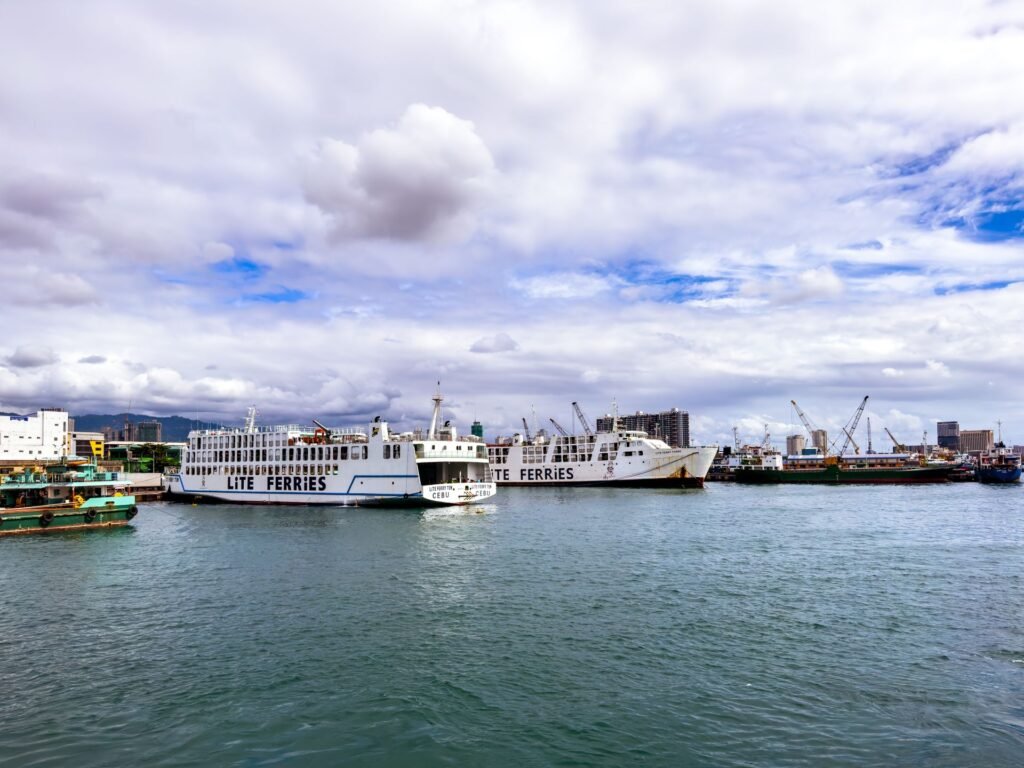
Mactan-Cebu International Airport (CEB) sits on Mactan Island, connected to Cebu City by two bridges. Expect 30 to 45 minutes to the city center depending on traffic and time of day. There is no need to book anything in advance for the transfer — taxis, ride-hailing and hotel shuttles all run from the terminal.
South Cebu: whale sharks, waterfalls and reef in one loop
South Cebu is a loop, not three separate day trips. Oslob, Moalboal and Kawasan Falls sit along the same coastal road, roughly in that order if you are coming from Cebu City, which is why most people do all three in a single very long day, or split the loop across an overnight in Moalboal.
Oslob: whale shark watching
| Item | Cost |
|---|---|
| Snorkeling — local | PHP 500 |
| Snorkeling — foreign tourist | PHP 1,000 |
| Scuba diving — local | PHP 1,000 |
| Scuba diving — foreign tourist | PHP 1,500 |
| Environmental/entrance fee | PHP 100 |
| Fin rental | PHP 100 |
| Camera rental | PHP 350 to 500 |
The fee covers a life vest, snorkel mask, 30 minutes in the water, the boat and paddlers, and in-water guides. Watching runs 6am to noon daily, with last entry around 11am — arriving at opening avoids both the crowds and the midday tour-bus rush.
The rules exist for a reason: no touching (stay at least 4 meters back), no flash photography, no sunscreen (wear a rash guard instead), no feeding except by the designated feeders, no diving below the sharks, and no chasing.
Worth knowing before you book: Oslob’s whale sharks are provisioned — fed by hand to keep them close to shore — and that practice is genuinely contested. The Large Marine Vertebrates Research Institute Philippines (LAMAVE), which has studied the site directly, describes the long-term impact on the sharks as unclear rather than settled either way, and found that most visitors who raise ethical concerns still go ahead and swim with them anyway. We are not telling you not to go. We think you should know this going in rather than find out afterward. Our Oslob whale shark guide goes through the research and the practical details in full.
Kawasan Falls canyoneering
The regulated rate is PHP 2,000 per person plus a roughly PHP 100 mandatory shuttle fee, so budget around PHP 2,100 if you book independently at the falls. Package tours with hotel pickup from Moalboal or Cebu City run PHP 2,200 to 3,500 per person.
The canyoneering route takes 3 to 5 hours depending on group size and pace: a mix of hiking, cliff jumps and slides down a series of waterfalls to the main Kawasan Falls pool. Life vests and helmets are mandatory and provided. Every jump is optional — guides walk you around any drop you would rather not take. Our Kawasan Falls canyoneering guide covers the current fee rules and the closure history.
From Moalboal it is 15 to 20 minutes by habal-habal (PHP 150 to 200) or tricycle (PHP 300 to 400). Direct from Cebu City it is a two-hour-plus drive, which is the main reason most people base themselves in Moalboal for this leg rather than day-tripping the whole loop from the city.

Moalboal: sardine run and turtles
Moalboal’s Panagsama Beach sits a short swim from a resident sardine bait ball — a dense, shifting column of millions of fish that shelters near the reef wall, with green sea turtles feeding nearby. As of 2026 it is still a daily fixture and the reason most divers and snorkelers add Moalboal to a south Cebu loop rather than skipping straight to Kawasan. Shore-entry snorkel trips are inexpensive and widely available directly from the beachfront; no boat is required to reach the sardines themselves.
North Cebu: Bantayan and Malapascua need their own trip
This is the part most guides get vague about: Bantayan and Malapascua are reached through two different ports, and neither connects directly to Cebu City by sea. You bus to a port first, then take a short boat crossing. Trying to combine them with the south Cebu loop, or with each other, in a single day is not realistic.
| Bantayan Island | Malapascua Island | |
|---|---|---|
| Bus from Cebu North Bus Terminal | To Hagnaya Port, about 4 hours, around PHP 260 | To Maya Port, about 4 hours, around PHP 230 |
| Ferry | Hagnaya → Santa Fe, about 1 hour, around PHP 300 including terminal fees, daily 1am to 5:30pm | Maya → Malapascua, about 30 minutes, PHP 200 per person, hourly 6:30am to 4:30pm |
| Arrival fee | PHP 30 ecological fee at Santa Fe | — |
| Total time, door to door | Around 5 hours | Around 4 to 4.5 hours |
| Total cost, budget travel | Roughly PHP 560 | Roughly PHP 430 |
Ferry tickets for both routes are sold in person at the terminal, not online, so build in some buffer rather than cutting it close to a departure. Bantayan is the better call for a quiet, long white-sand beach and a slower pace; Malapascua is the smaller island and the country’s best-known spot for thresher shark diving at Monad Shoal. Pick one rather than trying to island-hop between them on a short trip — there is no direct link between them either.
Cebu City itself
Cebu City is the oldest city in the Philippines and it shows. Magellan’s Cross, the Basilica del Santo Niño and Fort San Pedro sit within easy walking distance of each other downtown and cover a half day comfortably, tracing the Spanish colonial period back to the 1500s.
If your visit lines up with it, the city hosts the Sinulog Festival on the third Sunday of January every year (17 January 2027 next) — parades, street dancing and processions honoring the Santo Niño, and one of the largest festivals in the country. Expect flights and hotel rates to be considerably higher, and book well ahead if you want to be in the city for it.
When to go
Cebu falls under PAGASA’s climate Type III: seasons that are not sharply defined, relatively dry from November to April. That is a gentler pattern than much of the rest of the country, but it is not a guarantee — the central Visayas still sits inside the typhoon belt, and tropical cyclones can pass through outside that window. Whale shark watching and canyoneering both close temporarily in genuinely rough weather, for safety reasons rather than as a formality.
How many days do you need
- 3 days: one for Cebu City, one for the south Cebu loop (Oslob, Kawasan, a stop in Moalboal), one as a buffer or a slower half-day in Moalboal.
- 5 days: add an overnight to Bantayan or Malapascua — not both.
- 7 days or more: Cebu City, the south loop with a Moalboal overnight, then both Bantayan and Malapascua if diving or a genuinely slow beach stretch is the priority.
Do not try to fit the south loop and a north island trip into the same short visit. The ports are on opposite sides of the island and the logistics do not overlap.
Where to stay
| Base | Best for |
|---|---|
| Cebu City (IT Park / Lahug or the Waterfront area) | City sightseeing, restaurants, an easy airport transfer, and as a base if you are day-tripping rather than overnighting south. |
| Moalboal (Panagsama Beach) | The south Cebu loop — sardine run at your doorstep, short hop to Kawasan, manageable drive to Oslob. |
| Santa Fe, Bantayan Island | A slower, beach-first few days once you have made the ferry crossing. |
| Malapascua (Bounty Beach area) | Diving, especially thresher sharks at Monad Shoal; a small island that is easy to walk end to end. |
Check hotels for your dates: Cebu City (IT Park) · Moalboal · Santa Fe, Bantayan · Malapascua
Sources we checked: the December 2025 Guam route and current international schedule are reported in the Philippine Star’s coverage of MCIA’s secondary-gateway push. Oslob pricing and rules are cross-checked against Hale Manna’s 2026 Oslob guide; the provisioning debate draws on the Large Marine Vertebrates Research Institute Philippines. Kawasan Falls pricing follows Hale Manna’s canyoneering guide. Bantayan and Malapascua transport details are cross-checked between AskBantayan’s ferry schedule, Jonny Melon’s Bantayan route guide and his Malapascua route guide. Sinulog’s date is confirmed on its Wikipedia entry. Cebu’s PAGASA climate classification is the same Type III figure used in our Philippines-wide best time to visit guide.
Plan the rest of your trip
- Complete Cebu travel guide — the full hub: getting there, when to go, south and north Cebu, where to stay and how many days you need.
- How to get to Cebu — every route in from Manila, other Visayas islands and abroad.
- Best time to visit the Philippines — the region-by-region climate breakdown Cebu’s Type III classification comes from.
- Best time to visit Cebu — month-by-month weather for Cebu itself.
- Philippines travel budget guide — costing a multi-region trip.
- Philippines travel planning checklist — visas, SIM cards and what to sort before you fly.
- Complete Palawan travel guide — if Cebu is one stop on a wider Philippines itinerary.
Frequently asked questions
How many days do you need in Cebu?
Three days covers Cebu City and the south Cebu loop (Oslob, Kawasan Falls, Moalboal). Add two more if you want to include Bantayan or Malapascua island, and five or more to do both islands properly.
Can you do Oslob, Kawasan Falls and Moalboal in one day from Cebu City?
Yes, but it is a long day on the road. Most people who want to enjoy each stop rather than rush it choose to base themselves in Moalboal for a night instead.
Is swimming with whale sharks in Oslob ethical?
It is genuinely contested. The sharks are fed to keep them near shore, and the research group that has studied the site directly (LAMAVE) describes the long-term impact as unclear rather than resolved. We lay out the facts and the rules in the Oslob section above so you can decide for yourself.
How do you get to Bantayan Island from Cebu City?
Bus from the Cebu North Bus Terminal to Hagnaya Port, about 4 hours, then a roughly 1-hour ferry to Santa Fe. There is no direct sea link from Cebu City itself.
How do you get to Malapascua Island from Cebu City?
Bus from the Cebu North Bus Terminal to Maya Port, about 4 hours, then a roughly 30-minute boat crossing. This is a different port from the one used for Bantayan.
Does Mactan-Cebu International Airport have direct international flights?
Yes, and the list is growing: Philippine Airlines to Guam, Firefly Airlines to Kuala Lumpur, Vietnam Airlines to Hanoi, and a seasonal Jetstar route to Brisbane, alongside its usual domestic connections.
Next steps
- Book tours: Cebu tours on Klook
- Cost the whole trip: Philippines travel budget guide
- Check the season: Best time to visit the Philippines