
Last updated: 16 August 2026. Corrected to reflect the 29 March 2026 transfer of Cebgo and AirSWIFT flights from Manila NAIA to Clark. Tour rates, ferry fares and entrance fees are set locally and change often; confirm before booking.
Some links on this page are affiliate links. If you book through them, IslaVisit earns a commission at no extra cost to you. How this works.
Quick answer: the short version of Coron vs El Nido is this. Choose El Nido for lagoons, beaches and the better food scene, and Coron for wreck diving, quieter boats and lower prices. El Nido is the stronger single choice for a first trip to Palawan. Coron is the stronger choice if you dive, if you want fewer people at each stop, or if you are watching the budget. They sit about three and a half hours apart by fast ferry, so if you have ten days or more, the honest answer is to do both.
On this page
- The short version
- Getting there: the first real difference
- Lagoons versus lakes and wrecks
- Diving: where Coron genuinely wins
- What a day on the water actually costs
- The towns, food and evenings
- Where you sleep
- When to go
- Doing both: the ferry
- So which should you choose?
- Plan the rest of your trip
- Frequently asked questions
Coron and El Nido are the two names that dominate any Palawan search, and most comparisons flatten them into the same paragraph: both have limestone cliffs, both have turquoise water, pick either. That is not much help when you have five days and one flight to book.
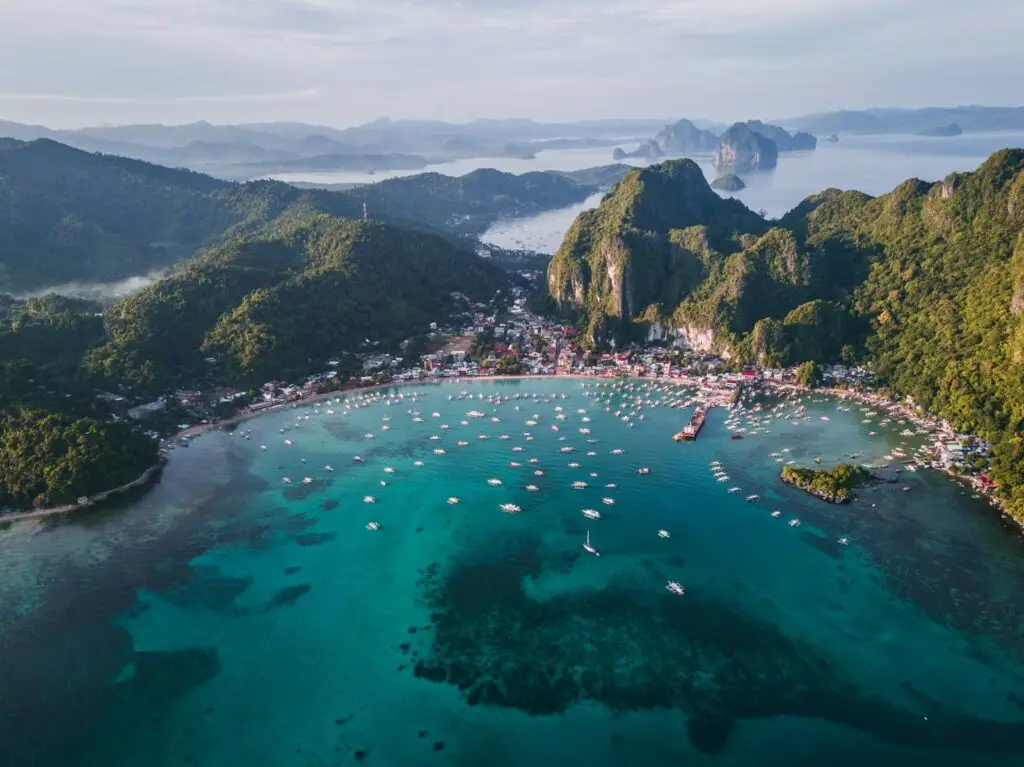
They are genuinely different trips. El Nido is a mainland town at the northern tip of Palawan facing a bay full of karst islands. Coron Town sits on Busuanga, a separate island roughly 150 kilometres north, and the sites people travel for are split between Coron Island opposite the town and a bay full of sunken Japanese warships. The scenery overlaps. The experience does not.
This guide compares them on the eight things that actually change your trip, using current 2026 prices and our own research from four El Nido guides.
The short version
| El Nido | Coron | |
|---|---|---|
| Best for | Lagoons, beaches, first-timers | Wreck diving, lakes, value |
| Getting there | Fly Clark to El Nido (about 1h 15m), or fly Manila to Puerto Princesa then a 5 to 6 hour van | Fly Clark or Cebu to Busuanga, then a 30 to 45 minute van |
| Airlines | Cebgo (ex-AirSWIFT) from Clark | Cebgo, Philippine Airlines, Sunlight Air |
| Signature sight | Big Lagoon and Small Lagoon | Kayangan Lake and the WWII wrecks |
| Joiner tour price | PHP 1,200 to 1,800 | PHP 1,500 to 2,500 |
| Fee structure | One-off PHP 400 pass, valid ten days | Paid per site, roughly PHP 100 to 300 each |
| Boat sizes | Larger joiner groups | Generally smaller groups |
| Food and nightlife | Better range, more international | Quieter, fewer options, cheaper |
| Luxury options | Extensive, including private islands | Limited |
| Days needed | 3 minimum, 5 comfortable | 3 to 4 |
Getting there: the first real difference
This changed in March 2026 and most guides have not caught up. Following a Department of Transportation ruling moving turboprop aircraft out of Manila’s NAIA, Cebu Pacific transferred all Cebgo and AirSWIFT flights to Clark on 29 March 2026. Those are the airlines serving both El Nido and Busuanga. Neither destination has a direct Manila flight any more.
That single change reshapes this comparison, so read this section before you book anything.
El Nido now has the better fallback. Puerto Princesa (PPS) still has frequent jet service from Manila and is the only Palawan gateway that does. Fly Manila to Puerto Princesa, then take a shared van 5 to 6 hours north for roughly PHP 700 to 900. It is a long day, but it starts where you already are. The alternative is Clark to El Nido in about 1 hour 15 minutes, which is quick in the air but means getting yourself roughly two hours north of Manila to Clark first.
Coron has no road option at all. Busuanga is a separate island, so you fly or you sail. Francisco B. Reyes Airport (USU) is now served from Clark and from Cebu by Cebgo, Philippine Airlines and Sunlight Air, and there is a short hop from El Nido. From the airport it is a 30 to 45 minute van transfer into Coron Town, commonly PHP 250 on a shared shuttle. If you are already in Cebu rather than Manila, Coron is the easier of the two by a wide margin.
One correction worth carrying into your planning: there is no ferry from Puerto Princesa to El Nido, and there is no longer a direct Puerto Princesa to El Nido flight either. From Puerto Princesa it is a road journey. Our full guide to getting to El Nido covers every route in detail.
The practical upshot: if you are flying in and out of Manila, El Nido is now marginally easier to reach, because Puerto Princesa gives it a jet-served fallback that Busuanga simply does not have. If you are routing through Cebu, Coron wins comfortably.
Lagoons versus lakes and wrecks
Both places are limestone karst. What sits inside the limestone is different.
El Nido is about lagoons and beaches. Bacuit Bay is a scatter of cliff-walled islands with enclosed lagoons you enter by kayak or through a crack in the rock. Big Lagoon, Small Lagoon and Secret Lagoon are the images that sell Palawan. El Nido also has proper mainland beaches you can reach without a boat, which Coron largely does not: Nacpan is a 45 minute drive north and is the kind of beach you can spend a whole day on. The four standard routes are covered in our guide to Tours A, B, C and D.
Coron is about lakes and water clarity. The headline sites sit on Coron Island, which is ancestral domain of the Tagbanua people and managed by them. Kayangan Lake is the one on every poster, reached by a steep 10 to 15 minute climb over a ridge and back down. Barracuda Lake is the stranger one: a brackish lake where the water temperature jumps sharply partway down, which is why divers go there. Twin Lagoon is split by a limestone wall you swim or duck under between the two halves.

If you want the classic Palawan postcard, that is El Nido. If you want water you can see thirty metres through and fewer boats sharing it with you, that is Coron.
Diving: where Coron genuinely wins
This is the clearest difference between the two, and it is not close.
On 24 September 1944, a United States air raid caught a Japanese naval supply fleet sheltering in Coron Bay and sank it. Those ships are still there. Seven main wrecks are dived regularly, including the Akitsushima, Irako, Okikawa, Kogyo, Tangat, Kyokuzan and the Morazan, and they span a useful range of difficulty rather than being a specialist-only site.
| Wreck | Depth | Who it suits |
|---|---|---|
| Okikawa Maru | 10 to 26 m | Open Water divers, shallow sections |
| Morazan / Olympia Maru | 12 to 25 m | Open Water divers |
| Kogyo Maru | 22 to 36 m | Advanced and wreck-certified |
| Tangat / Olympia | 23 to 30 m | Advanced and wreck-certified |
| Akitsushima | 22 to 36 m | Deep and technical |
| Irako | 34 to 45 m | Deep and technical |
| Kyokuzan Maru | 22 to 39 m | Deep and technical, best visibility |
Two-dive wreck trips start from around PHP 2,000. Visibility across the bay ranges from about 3 to 20 metres depending on the site and conditions, with the Kyokuzan regularly the clearest.
The practical point: if you are Open Water certified, you can dive real wrecks in Coron on a normal recreational ticket. The shallow sections of the Okikawa and Morazan sit within recreational limits. That is unusual, and it is the single best reason to pick Coron over El Nido.
El Nido has diving, and it is pleasant reef diving. It is not why anyone books a flight.
What a day on the water actually costs
Both places charge fees on top of the tour price. The structures are completely different, and this is where a lot of budgets go wrong.
El Nido front-loads it. You pay a one-off Eco-Tourism Development Fee, most 2026 sources putting it at PHP 400 per person, before your first tour. It is valid for ten days and covers every route you do inside that window. On Tour A you also pay roughly PHP 200 for the Big Lagoon entrance and about PHP 150 for kayak hire. After day one, additional tour days carry no further fees.
Coron charges per site. The lakes and beaches on Coron Island are managed by the Tagbanua community, and each site collects its own entrance fee at the stop.
| Site | Typical fee |
|---|---|
| Kayangan Lake | PHP 300 |
| Malcapuya Beach | PHP 250 |
| Twin Lagoon | PHP 200 |
| Barracuda Lake | PHP 200 |
| Banol Beach | PHP 200 |
| Bulog Dos | PHP 200 |
| Skeleton Wreck | PHP 150 |
| Smith Beach | PHP 150 |
| Siete Pecados | PHP 100 |
Work that through and the arithmetic flips depending on how long you stay. A first tour day in El Nido lands around PHP 1,950 to 2,250 once the pass, Big Lagoon entrance and kayak are added. A comparable first day in Coron, taking in Kayangan Lake, Twin Lagoon and the Skeleton Wreck, lands around PHP 2,150 to 2,650.
On day two the gap widens. A second El Nido tour costs only the tour itself, roughly PHP 1,400 to 1,700. A second Coron day picks up a fresh set of site fees and stays near PHP 2,100 to 2,400.
So Coron is cheaper to sleep and eat in, but El Nido is cheaper to be on the water in, and the longer you stay the more that is true. Most comparisons get this backwards. Our Philippines travel budget guide puts both into the context of a full trip.
The towns, food and evenings
El Nido Town is small and walkable, with restaurants and bars along the beachfront and a genuine range of food, including a good amount of international cooking aimed at travellers. It is livelier and noticeably busier than the photographs suggest. If you like a town to have some energy after the boat comes in, El Nido has it.
Coron Town is also small and walkable but more spread out, arranged along the waterfront and the National Highway, with dive shops rather than beach bars setting the tone. There is less choice at dinner and less happening afterwards. What you get in exchange is lower prices and the sense that the town is a working town that also has tourists, rather than the reverse.
One thing to know about Coron Town: it is not a beach town. The waterfront is a port. Swimming happens on the boat trips, not off the front of your hotel. Travellers who book Coron expecting to walk out onto sand are regularly disappointed.
Where you sleep
El Nido has the deeper range at both ends. Budget rooms start around PHP 450 a night, mid-range sits between PHP 1,500 and 5,000, and the top end runs to private-island resorts at PHP 10,000 to 25,000 and above. Our El Nido hotel guide breaks this down by area, which matters more than the property itself.
Coron is better value in the middle and has less at the top. Dorm beds run around PHP 600, guesthouses sit in the rough equivalent of USD 15 to 30, and comfortable mid-range hotels land around USD 60 to 110. Genuine luxury is limited to a handful of resorts on outlying islands.
If your trip has a splurge night in it, El Nido has more to splurge on. If you want a clean, comfortable room at a fair price, Coron does that better.
Check rooms for your dates: El Nido · Coron
When to go
Both run on the same two monsoons, so the broad answer is the same: the dry season is roughly November to May, and the wet season is roughly June to October.
Within that, the details differ slightly. In El Nido, February is the driest month on every dataset and carries the lowest tour-cancellation risk of the year; our month-by-month guide puts the sweet spot at mid-January to mid-March. Coron follows the same shape, with December to February the most comfortable and March to May the hottest.
A caveat on typhoons: several guides claim Coron is meaningfully more exposed than El Nido because it sits further north. We could not find data supporting that. PAGASA publishes no cyclone frequency breakdown below national level, and the one source rating Palawan month by month treats the whole province as equally sheltered. What is true for both is that ferry services between them are suspended in rough water, which matters if you are combining the two.
If you are travelling in the wet season and can only pick one, El Nido is the marginally safer bet.
Doing both: the ferry
If you have ten days or more in Palawan, do not choose. The two are connected by fast ferry in about three and a half hours.
| Operator | Frequency | Journey | Rough fare |
|---|---|---|---|
| Montenegro Lines | Daily, around midday | About 3h 30m | PHP 2,850 |
| Atienza Interisland | Daily, early afternoon | About 3h 30m | PHP 2,850 |
| Phimal Fast Ferry | Tue, Thu, Sat mornings | About 3h 40m | PHP 2,750 |
| Jomalia Shipping | Daily, early afternoon | About 3h 30m | PHP 3,200 to 3,250 |
| Slow cargo ship | Weekly, Wednesdays | About 8h | From PHP 2,400 |
Two practical warnings. In peak season, roughly December to April, these sail full and tickets go several days ahead, so book before you arrive. In the wet season, crossings are cancelled for rough seas often enough that you should not put a same-day onward flight on the other side of one.
Direction matters less than people think, but flying into Coron and out of El Nido tends to work better, because El Nido has the direct Manila connection for your flight home and the ferry runs in the calmer morning half of the day.
Coron vs El Nido: so which should you choose?
| If you are… | Choose |
|---|---|
| Visiting Palawan for the first time | El Nido. The lagoons are what you pictured. |
| A certified diver | Coron, without hesitation. |
| On a tight budget | Coron for accommodation and food, but budget for per-site fees. |
| Staying four days or more on the water | El Nido. The ten-day fee pass pays for itself. |
| Short on time, flying via Manila | El Nido. Puerto Princesa keeps its Manila jet service. |
| Routing through Cebu | Coron. Direct Cebu to Busuanga flights. |
| Travelling with children | El Nido. Mainland beaches mean not every day is a boat day. |
| Wanting a quiet trip | Coron. Smaller boats, fewer people per stop. |
| Planning a honeymoon or a splurge | El Nido. The high-end resorts are there. |
| Travelling in June to October | El Nido, marginally. Lower typhoon exposure. |
| In Palawan for ten days or more | Both. Take the morning ferry. |
If we had to pick one for a reader who has never been to the Philippines and has five days: El Nido. It is the more complete destination, the scenery is the reason Palawan is famous, and there is enough to do that a cancelled boat day is not a wasted day. Start with our complete El Nido travel guide.
If you dive, ignore all of that and go to Coron.
Sources we checked: Flight route changes verified against Cebu Pacific’s own transfer advisory. Typhoon frequency from PAGASA.
Plan the rest of your trip
- Coron itinerary — 3, 4, 5 and 7 days planned out, including a diver version.
- Complete Palawan travel guide — all three destinations compared, and how to combine them.
- El Nido itinerary — 3, 5, 7 and 10 days planned out, with tour sequencing.
- Complete Coron travel guide — getting there, timing, tours, diving and where to stay, in one place.
- Where to stay in Coron — town or island, where beachfront actually exists, and what “cheap resort” means here.
- Coron island hopping — the tours, the lakes and every entrance fee.
- Coron wreck diving — the WWII fleet, depths and costs.
- Best time to visit Coron — month by month weather, rain and costs.
- Complete El Nido travel guide — getting there, timing, tours and where to stay, in one place.
- Where to stay in El Nido — the four areas compared, for the El Nido half of the trip.
- How to get to El Nido — every route compared, including the Coron ferry.
- El Nido island hopping tours — what Tours A, B, C and D actually visit.
- Best time to visit El Nido — month by month, with cancellation risk.
- Philippines travel budget guide — where Palawan sits in a full trip budget.
- How to get to Coron — every route in 2026, including the Manila flight that no longer exists.
Insurance worth checking: wreck diving and island hopping are two of the activities standard policies most often exclude. Compare travel insurance quotes on EKTA and read the activity list rather than the headline price.
Frequently asked questions
Is Coron or El Nido better?
El Nido is better for lagoons, beaches, food and luxury stays, and is the stronger choice for a first visit to Palawan. Coron is better for wreck diving, quieter boat trips and value for money. Neither is objectively better; they suit different trips.
How do you get from El Nido to Coron?
By fast ferry, in about three and a half hours. Montenegro, Atienza and Jomalia run roughly daily around midday, and Phimal runs Tuesday, Thursday and Saturday mornings. Fares sit around PHP 2,750 to 3,250. A weekly slow cargo ship takes about eight hours from around PHP 2,400.
Can you do Coron as a day trip from El Nido?
No. The crossing alone is three and a half hours each way, and Coron tours are full-day trips. Give Coron three days minimum if you are going at all.
Is Coron cheaper than El Nido?
For accommodation and food, yes. For time on the water, not necessarily. El Nido charges a one-off PHP 400 fee valid for ten days, while Coron charges PHP 100 to 300 at each site you visit, so a multi-day tour itinerary can work out more expensive in Coron.
Do you need to dive to enjoy Coron?
No. Kayangan Lake, Twin Lagoon and Barracuda Lake are all snorkelling and swimming sites, and the Skeleton Wreck sits shallow enough to snorkel over. But diving is Coron main advantage over El Nido, so if you never get in a tank you are choosing it for the quieter version of scenery El Nido does better.
How many days do you need for both?
Ten days is comfortable: five in El Nido, three to four in Coron, and a day for the ferry. Eight is possible but tight, and leaves no slack for a weather cancellation.
Which has better beaches?
El Nido, clearly. It has mainland beaches you can reach without a boat, including Nacpan about 45 minutes north of town. Coron Town has no swimming beach of its own; the good sand is on the island trips.
Next steps
- Start here if you pick El Nido: Complete El Nido travel guide
- Pick your base: Best hotels in El Nido, by budget and area
- Check current tours and prices: Palawan tours on Klook
- Sort your flights: Compare Manila to Palawan fares
- Cost the whole trip: Philippines travel budget guide