Last updated: 16 August 2026. Dive prices and site surcharges are set by operators and change; confirm before booking.
Some links on this page are affiliate links. If you book through them, IslaVisit earns a commission at no extra cost to you. How this works.
Quick answer: Coron wreck diving exists because of one morning. On 24 September 1944 a United States carrier strike caught a Japanese naval supply fleet sheltering in Coron Bay and sank it. Those ships are still there, and the reason Coron matters to divers is that they span a genuinely useful range of depths. A newly qualified Open Water diver can dive real WWII wrecks here, which is unusual. Three-dive day trips run PHP 5,500 to 6,900 including boat, guide, lunch and usually gear. The best months are December to March.
Browse Coron tours and activities on Klook →
On this page
Coron is one of a small handful of places in the world where recreational divers can put their hands on an intact WWII fleet. It is the single strongest reason to choose Coron over El Nido, and if you are certified it is not a close call.
What happened here in 1944
By September 1944 the Japanese Navy had moved a supply fleet south from Manila to what it assumed was a safe anchorage among the Calamian Islands. It was not safe. American reconnaissance found it.
On the morning of 24 September 1944, aircraft from Task Group 38.3 launched from carriers roughly 340 miles away — at the time one of the longest-range carrier strikes ever attempted. The strike package is widely reported as 96 Grumman F6F Hellcat fighters and 24 Curtiss SB2C Helldiver dive-bombers. They took off around 05:50, arrived over Coron Bay around 09:00, and left roughly a dozen ships sunk or burning. Every American aircraft returned.
What that produced, eighty years on, is a cluster of large steel ships in warm, sheltered, mostly shallow water. Coral has done the rest.
The wrecks, by depth and certification
| Wreck | Depth | Certification needed | Notes |
|---|---|---|---|
| Okikawa Maru | 10 to 26 m | Open Water | The largest wreck, a 160 m tanker. Deck at 10 m. The classic first Coron wreck. |
| Morazan / Olympia Maru | 12 to 25 m | Open Water | Shallow, well lit, easy swim-throughs in the holds. |
| Tangat / Olympia | 23 to 30 m | Advanced, wreck cert useful | Intact, upright, good penetration lines. |
| Kogyo Maru | 22 to 36 m | Advanced, wreck cert useful | Cargo still in the holds, including construction material. |
| Akitsushima | 22 to 36 m | Deep / technical | A seaplane tender with its crane collapsed across the seabed. The most dramatic. |
| Kyokuzan Maru | 22 to 39 m | Deep / technical | Furthest out, off north Busuanga. Regularly the clearest water, 20 m plus. |
| Irako | 34 to 45 m | Deep / technical | The best wreck in Coron and the most demanding. Operators commonly gate it behind 50+ logged dives and a deep certification. |
What you can dive as an Open Water diver
This is the question that decides whether Coron is worth the flights, so here is the honest version.
Yes, you can dive real wrecks on an Open Water ticket. The Okikawa Maru and the Morazan sit shallow enough that their decks and upper structures are comfortably inside 18 metres. You are swimming over and alongside an intact WWII ship, not looking at it from above. That is the real thing.
What you cannot do is the deep hulls, the engine rooms, or the Irako. Penetration beyond the light zone needs wreck training regardless of your depth certification, and the best three wrecks in the bay start below 22 metres.
If you have four days and you are already Open Water, the strongest value move in Coron is doing your Advanced here, on these wrecks, for PHP 20,000 to 22,000. You get five training dives on sites you would otherwise be excluded from, and you leave qualified for the rest of them.
What Coron wreck diving costs
Coron is sold as day-trip packages rather than single dives. No operator we checked publishes a walk-in single-dive rate.
| What | Price range | Notes |
|---|---|---|
| 3-dive wreck day trip | PHP 5,500 to 6,900 | Boat, guide, lunch, park fees. Gear included by most. |
| 2-dive day trip | PHP 4,000 to 5,400 | Finishes early afternoon. |
| Discover Scuba (intro, 2 dives) | PHP 6,300 to 7,300 | No certification needed. |
| PADI Open Water | PHP 23,000 to 25,000 | 2 to 3 days. |
| PADI Advanced Open Water | PHP 20,000 to 22,000 | 2 days, 5 dives. Best value in Coron. |
| Wreck or Deep Specialty | Around PHP 19,500 | What unlocks the Irako. |
| Nitrox Specialty | Around PHP 15,000 | Fills about PHP 600 per tank. |
| Multi-day packages | PHP 16,000 for 9 dives | Roughly PHP 1,780 per dive. |
| Barracuda Lake surcharge | PHP 300 per diver | Some operators require a minimum of 4 divers. |
| Equipment rental | Included, or PHP 800 per day | Bringing your own can earn a PHP 400 per day discount. |
| Non-diving companion on the boat | Around PHP 1,800 | Includes lunch, drinks and park fees. |
Implied per-dive cost on a three-dive day works out at roughly PHP 1,830 to 2,300. Multi-day packages bring that down meaningfully, so if you are diving more than twice, ask about them before booking day by day.
Be careful with third-party price lists. Several aggregator pages still quote figures well below what the operators themselves publish, and one price list circulating online is dated 2001.
Choosing an operator
Coron has a mature dive scene and the differences between shops are real but not dramatic. What actually varies:
- Coron itinerary — 3, 4, 5 and 7 days planned out, including a diver version.
- Complete Palawan travel guide — all three destinations compared, and how to combine them.
- Complete Coron travel guide — getting there, timing, tours, diving and where to stay, in one place.
- Whether gear is in the price. Most shops include a full set. At least one itemises it at PHP 800 a day, which makes a headline price look cheaper than it is. Ask.
- Group size and minimums. Barracuda Lake and some deeper wrecks need a minimum of four or five divers to run, or carry a small-group surcharge.
- Experience gates on the Irako. The better shops require 50 or more logged dives plus a deep certification. Treat a shop that will take anyone down there as a red flag rather than a bargain.
- What is bundled. Hotel pickup, cooked lunch, drinks, marine park fees and dive computers are included by some and charged by others.
Coron has at least one PADI 5 Star Instructor Development Centre and several long-established shops with well over a decade of local operation. Pick on inclusions, group size and how carefully they ask about your logbook — not on the headline number.
Barracuda Lake: the strange one
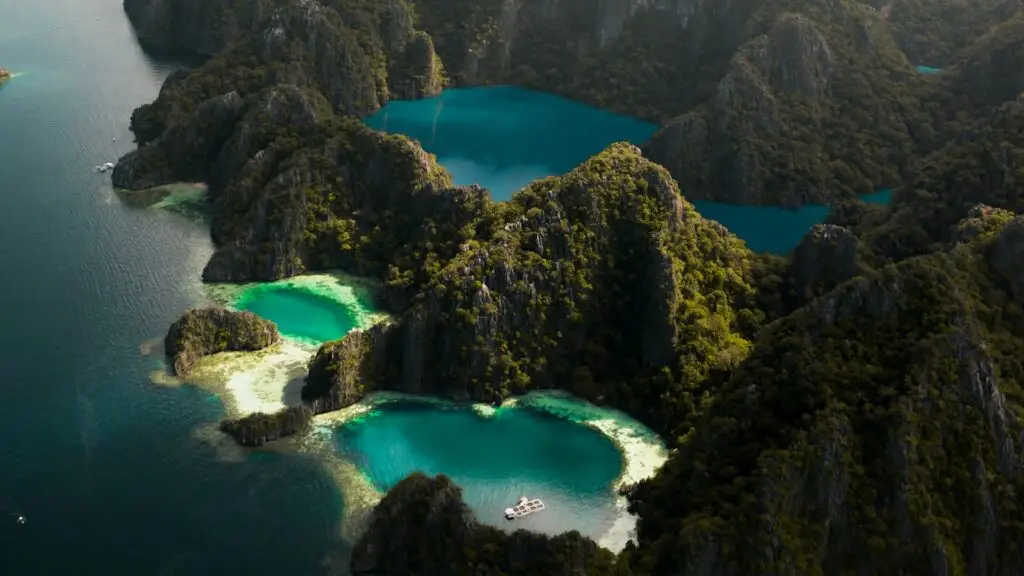
Barracuda Lake is not a wreck dive and it is not really a wildlife dive. People do it because the water behaves oddly.
It is a collapsed limestone sinkhole with geothermal activity beneath it, reaching about 40 metres. Fresh water sits on top at around 28°C. At roughly 14 metres you hit a thermocline and the temperature climbs to about 38°C — the reverse of a normal thermocline, and it feels like swimming into a bath. The hot layer runs down to about 26 metres. There are visible haloclines where fresh, brackish and salt water meet, and the shimmering distortion at each boundary is the point of the dive.
Marine life is sparse: some barracuda, gobies, groupers. Visibility is 10 to 20 metres with little current, and below about 35 metres the silt kills it entirely.
Certification: Advanced is recommended, but the thermocline at 14 metres sits inside Open Water limits, so an Open Water diver gets the main attraction. Expect roughly PHP 200 to 300 in site fees on top of your dive price; sources disagree on the exact figure, so confirm what your operator has included.
Access is by boat, then a climb over a limestone ridge carrying your gear. Reports of how hard that carry is vary from “short walk” to “thirty minutes with a tank on your back”; plank walkways and stairs have been improved over the years, but it is not a flat stroll.
If you do not dive
Three of the wrecks are genuinely snorkellable, which is unusual and worth planning around.
Lusong Gunboat is the best of them. The stern breaks the surface at low tide and the wreck runs from essentially zero down to about 10 to 12 metres. Thirty metres long, completely encrusted in hard coral, and functioning now as an artificial reef. It sits off southwest Busuanga near Lusong Island, further from town than the Coron Island lakes and consequently much quieter. Usually paired with Lusong Coral Garden on Reef and Wrecks tours.
Skeleton Wreck is the one on the standard island-hopping circuit, with its shallowest sections around 5 metres and the deepest around 22. The timber has rotted away leaving a coral-covered metal frame. One operator lists it deeper than others, so if snorkelling it is the point of your day, ask before booking.
East Tangat runs from about 3 to 22 metres on a slope, so the shallow end is comfortably at snorkel depth.
If your partner dives and you do not, most shops will sell you a place on the dive boat for around PHP 1,800 including lunch and park fees, which beats waiting in town.
When to come, and visibility
December to March is the consensus window for the best conditions and the best chance of good visibility on the wrecks. That sits inside the amihan dry season, when the sea is calmest and boats run reliably.
Visibility across the bay ranges from about 3 to 20 metres depending on site, season and how recently it has rained. The Kyokuzan Maru, furthest out off north Busuanga, is regularly the clearest at 20 metres and above. Inner-bay wrecks are siltier.
The wet season, June to October, brings reduced visibility, more cancelled boat days and some operators running shorter schedules. Diving is still possible; it is just less reliable. Our Coron and El Nido comparison covers how the seasons differ across northern Palawan.
Safety and flying home
Two things specific to Coron are worth planning for.
Leave a proper surface interval before flying. Standard guidance is at least 18 hours after multiple dives or multi-day diving. This matters more in Coron than in most places because the deep wrecks encourage repetitive deep profiles, and because your flight out is a turboprop to Clark or Cebu, not a jet from a major hub — there is no easy same-day alternative if you cut it fine and change your mind. Plan a full non-diving day before departure.
Take the depth gates seriously. The Irako sits at 34 to 45 metres. That is technical territory, and the operators who insist on 50 logged dives and a deep certification are protecting you, not upselling you.
If you are diving several days, nitrox is worth the money here specifically because the profiles are deep and repetitive.
Sources we checked: Wreck depths and certification levels cross-checked against Scuba Tech Philippines’ wreck-by-wreck breakdown.
Plan the rest of your trip
- Complete Coron travel guide — getting there, timing, tours, diving and where to stay, in one place.
- Where to stay in Coron — town or island, where beachfront actually exists, and what “cheap resort” means here.
- Best time to visit Coron — month by month weather, rain and costs.
- How to get to Coron — every route in 2026, including the Manila flight that no longer exists.
- Coron island hopping — the tours, the lakes and every entrance fee.
- Coron vs El Nido — why divers should choose Coron.
- Philippines travel budget guide — where diving sits in a full trip budget.
Insurance worth checking: recreational scuba is excluded from a surprising number of standard travel policies, and depth limits often cap at 18 or 30 metres, which matters on these wrecks. Compare travel insurance quotes on EKTA and check the diving clause and its depth limit specifically.
Frequently asked questions
Can a beginner dive the Coron wrecks?
Yes. The Okikawa Maru and Morazan have substantial structure inside Open Water limits, so a newly certified diver can dive genuine WWII wrecks. The deeper wrecks and any real penetration need Advanced and wreck training.
How much does wreck diving in Coron cost?
A three-dive day trip runs PHP 5,500 to 6,900 including boat, guide, lunch and marine park fees, with gear included by most operators. Two-dive trips run PHP 4,000 to 5,400. Multi-day packages bring the per-dive cost down to around PHP 1,780.
How many wrecks are there in Coron?
Around a dozen ships were sunk or left burning on 24 September 1944. Seven are dived regularly, and three of those are shallow enough to snorkel.
Which is the best wreck in Coron?
The Irako, by common consent, but it sits at 34 to 45 metres and most operators require 50 or more logged dives plus a deep certification. For divers within recreational limits, the Akitsushima is the most dramatic and the Okikawa Maru the most accessible.
Do I need to be certified to dive in Coron?
No. Discover Scuba programmes run PHP 6,300 to 7,300 for two dives with an instructor and no prior certification. If you want to dive the wrecks properly, an Open Water course here costs PHP 23,000 to 25,000.
Is Barracuda Lake worth diving?
If you like unusual conditions, yes. The water goes from about 28°C to 38°C at around 14 metres, which is memorable. If you want marine life, no. It is a scenic dive with sparse life.
When should I stop diving before my flight?
Leave at least 18 hours after multi-day or repetitive diving, and plan a full non-diving day before departure. Flights out of Busuanga are limited turboprop services to Clark or Cebu, so there is little flexibility if you need to change plans.
Next steps
- Sort your route in: How to get to Coron
- Fill your non-diving days: Coron island hopping tours
- Book boats and transfers: Coron activities on Klook
- Cost the whole trip: Philippines travel budget guide